Thursday, May 27, 2010

Kuwait National Museum

When you shift base to a new country the best place to know about that country, its history, culture and custom is to visit its museums. That’s the first step we took after landing in Kuwait. We visited the Kuwait National Museum. After that many more visits followed taking parents, in-laws, my brother and friends.

Located in Kuwait City on the Arabian Gulf Street between the Seif Palace and the National Assembly (Parliament), the Kuwait National Museum was planned by Michel Ecochard. A few feet away, there is Al Sadu house which faces the Gulf street. Though the architectural project and the plans of the museum were ready in 1960, actual construction started only in 1981. It was on February 23, 1983 that two of the four buildings were inaugurated; the planetarium was opened on February 16, 1986. One of the four blocks of the museum houses all administrative wings, offices and an auditorium. The permanent exhibits are displayed in the other three blocks.

The museum has an interesting history. It was originally the residence of Sheikh Ahmed Al Jaber Al Sabah. But the archaeological discoveries at Failaka created a need for a place to house these important finds. A department of Antiquity and Museums was also set up by the government and the department bought the former home of the Al Badr family in Kuwait City and turned it into the national museum.

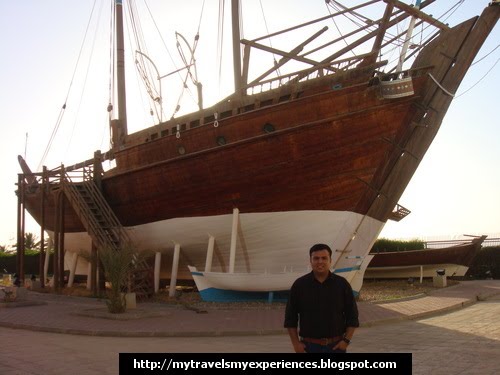
                                                        Boom Al-Muhallab(a very big dhow) is part of the museum


A tour of the Kuwait National Museum of Kuwait makes you discover the wonderful art collection of the Al-Sabah dynasty. The rich trading history of Kuwait is unfolded in the treasure trove displaying archaeological findings of the Failaka Island, various artifacts and the remnants of the ancient pear diving dhows.

The roofs of the building are of concrete with an aluminum frame covering the garden and the buildings.

Upon entering the guard takes your civil ID and gives you a visitors badge. The entry to the museum is free.

There are two types of museums, the first museum is a display of artifacts found on Failika island during an archaeological dig, wooden doors of the past, terracotta and engraved tools, animal fossil which is 16million old, group of blades and cutters from flint stone and Neolithic age, silver statues and bronze coins from the bronze period and Hellenistic period. But when we first visited the museum it had exhibits at two floors. The ground floor was the same but the first floor had musical instruments and various types of radios used in the past. But in our later visits, we found the first floor closed and there were no exhibits.

The next museum is my favorite. It's a museum of Kuwaiti heritage. It looks like Kuwait during the 40's and 50's, like a small village. The displays include statues imitating the old ways of Kuwait. From merchants selling their goods to what a typical Kuwaiti house looked like before the invasion of modern technology. So simple were the olden days. There are old photos dating back to 1942. You will come to know that Kuwait was once a simple trading hub and that a lot of people depended on the sea for earnings. In the next post I will write in detail about the Heritage Museum.

Although the museum was looted, burned and destroyed by Iraqi invaders, efforts to restore most of the artifacts and important materials were made. Even today there's plenty to do and view at the four buildings and the planetarium that make up the National Museum. But one thing I noticed is that it is the most neglected place when you compare with other places of interest. I feel the government should pay more attention to it.

Anyhow, it is a real great place to visit if you're interested in the past.
 
Museum Visiting Hours :

Monday to Saturday: 8.30-12.30AM   4.30- 8.30PM
Friday        Morning off.         Afternoon :  4.30-8.30

Wednesday, May 26, 2010

Al Sadu Weaving, Q8

Al Sadu weaving is an embroidery form in geometrical shapes hand woven by Bedouin people. This traditional art form was developed by the nomadic Bedouins over centuries, and was facing extinction because of modernization. To protect this traditional art form of hand weaving with dyed, spun and colored wool, the Al-Sadu Society was formed in 1979. In addition to reviving the ethnic art of hand weaving, they also contributed a lot to protect the Bedouin community. As a result of the society's efforts, the Sadu House came up in 1980. Towards 1984 end, the Sadu House had registered 300 Bedouin women and they are producing about seventy different items every week.

The Al Sadu House which protect the interests of the Bedouins and their ethnic handicrafts is a unique tourist attraction of Kuwait and is located close to the National Museum.

I have already written about Al Sadu House and the Al Sadu Weaving in details earlier. But in my earlier post did not share much pictures. This time when I visited with my brother, I took few pictures which I am sharing.


Tareq Rajab Museum of Islamic Calligraphy, Q8


After our visit to Tareq Rajab Museum, we hurriedly drove to the Tareq Rajab Museum of Islamic Calligraphy as they too close at 7pm and we did not have much time at hand. The visiting hours of the Calligraphy Museum is same as that the Tareq Rajab Museum and is on the same street as the Dar al Cid, where many art exhibits are held, also under the patronage of the Tareq Rajab family.

The Museum of Calligraphy is down the street in front of the museum, turn right at the end of the street, turn right again when the street ends and you will see a huge parking lot – the beautiful building is the Museum of Calligraphy, and you can park in the parking area there. Just in front of the museum is the New English School, which was also founded by Tareq S. Rajab in 1969. It is a co-educational school that has British curriculum.


The museum is impressive and well organized. It has a beautiful collection of calligraphic art and artifacts. But we found that most of the exhibits had no explanations so we didn’t know the significance of what we were seeing that were so impressive. The calligraphy is manifest in hangings, ancient Qurans, quilting, posters and carved wood. Each item is a work of art. The Islamic Arabic Chinese calligraphy is probably one of the most interesting collection at the museum. Chinese calligraphy on its own is fabulous and stunning but seeing it done in Arabic lettering was totally new.  

But hope to find explanation on all the exhibits when I visit it next time.

I think if you are in Kuwait you must visit BOTH the museums.

Tuesday, May 25, 2010

Tareq Rajab Museum, Q8

Another place worth visit is the Tareq Rajab Museum which is a private museum located in a villa in Jabriya(area12), that specializes in Islamic arts and crafts. This museum is the brain child of Tareq Sayed Rajab and his wife Jehan Wellborne.

Tareq Sayed Rajab, after completing his studies in US, married Jehan Wellborne in the year 1955 and since then they had a plan of constructing their own museum. This is how the idea of constructing the Tareq Rajab Museum came to existence and presently the museum displays around ten thousand collected items. Jehan Wellborne was passionate about researching on the lifestyle and culture of different types of people and their culture. Tareq's wife was also interested in the folklore and other traditional subjects. After getting married to Tareq Sayed, she worked on all these things and the collection of the items in the museum are the memories of her works.

The Department of Antiquities and Museums in Kuwait selected Mr. Tareq Sayed Rajab as its Director. He was the first Director of the department but left the post after few years(1969) and joined his wife in her works. They traveled most of the rural areas of the Middle East and Saudi Arabia and researched on their lifestyle. The Tareq Rajab Museum in Kuwait represents the valuable effort and works through the precious collections. In 1980, after long tours of travelling and collecting articles they finally were able to open a museum for the public. In their search for antique exhibits they travelled more than half of the world and collected artefacts. Thus now the Tareq Rajab Museum in Kuwait has a collection of over thirty thousand items, of which about ten thousand are permanently on for public display.A large collection of ethnic and Islamic gold and silver jewellery,manuscripts,metalworks,textiles,embroideries,costumes,ceramics,and musical instruments can be viewed that are pleasingly displayed . You will find gold and silver jewelleries from China, Malaysia, Indonesia, Eastern Europe, Tibet, Nepal, India, Yemen, Greece, Egypt, Portugal, Thailand and UK. The second room/ hall consist of brass jewellery from Sri Lanka (Ceylon), India (Kashmir,Mysore, Nagaland), Egypt, Syria, Iran, Tunisia, Morocco,Iraq, S.Africa, Oman, Saudi, Yemen, Uzbekistan and special Kundan jewellery of India.Musical instruments from India and Arab countries and dresses from Syria, Palestine, Jordan are nicely laid out in different rooms. In another room, you will find Middle Eastern Gold Jewellery from the 2nd-3rd AD, in another you will find firearms of the Islamic world and in another jewellery of the Mogul period (where a Jaipur enamal work of 18th century) is the main attraction. The things used by Turkomans are also displayed. Turkomans who now mainly live mainly in USSR, Iran, Afghanistan are the descendants of the Central Asian tribes who invaded the regions east of the Caspian Sea. Silk dresses and jewellery from Afghanistan and Uzbekistan is displayed in another room, another space is dedicated to the shawls from Kashmir and Hyderabad. In the next room, you will find dress's and jewelleries from Turkey, Egypt, S.Arabia, Sudan and India.

Relatively in a bigger room you will find the first hand written smallest Quran in the world. In the same room , you will incense burner (12th Century), Shields (19th Century), Glassware from 8th- 13th Century, Bowls of 11th and 12th Century, Lampshades of 12th N 13th century, Perfume stands of different shapes and sizes from 7th to 10th Century. Also pottery of the Fatimad period, from Egypt and Syria (9th and 10th Century), Persian “Minali” of 12th and 13th Century and gold luster Kashan from 12th -13th Century are part of the collection of the museum. There are lots of coins specially gold coins of 188AD, 803AD, 805 AD, and Gold Coins and Dinars from 697AD to 749AD are in display also. Mughal miniature paintings from mid 19th century are another attraction of the museum. Also early Islamic manuscripts are also in display. Arabic manuscript on gazelle skin, written for Muzaffa Al Sin Shah Qajar, who reigned from 1896 to 1907 are in display.

There is a reference library also in the Tareq Rajab Museum in Kuwait. This library can be regarded as a 'goldmine of information' for the benefit of those who want to learn about the culture and heritage of the Islamic and the Arab world.

During the Iraqi invasion in 1990, most of the belongings of the one side of the museum was packed away in boxes and then locked off in a safe place. Since all the belongings could not be packed away therefore the side where exhibits were still present was blocked off from the place where the boxes containing exhibits was kept. The reference library was used as a bomb shelter during the aerial warfare. The Museum was reopened in September 1991.

The museum is one of the the first places I visited after arriving in Kuwait. After that when my parents, in-laws and then my brother came we took them to the museum. But last time that we visited the museum i.e. when we took my brother then I was terribly upset as they had put an entrance fee of 2KD per person. Before that entrance to the museum was free. Don’t know what made them to introduce the entrance fee but personally I feel 2KD is too much.

Address -Tareq Rajab Museum
Block 12, Street 5 House 22 , Jabrieh Area
Kuwait City, Kuwait
phone: +965 531 7358
fax: +965 533 9063
email: museum@trmkt.com
website: http://www.trmkt.com/startmain.htm

The museum is open daily
The visiting hours are as follows
Morning 9-12pm
Afternoon 4-7pm
Friday 9-12pm


Visit to Mishref Exhibition Ground, Q8

When my brother visited us there was exhibition of Arabic food  items and IT n Communications exhibition going on at Kuwait International Fair Ground in Mishref. We decided to take him to Mishref as it is the best way to have a feel and experience of Arabic food , culture and people. He was very happy to see so many Arabic people, taste their food ( sweets and Shawarma) and to have seen the latest technology gadgets.


 In the IT & Communications exhibition that was held at Hall no 8 , there was arts and crafts going on for kids. They were given all the necessary things and they had to draw or make a fish with the colour papers. Mehr is too young to be part of such activities but as they insisted I helped her in making a fish. Also a quiz competion and a football match was held.


I had already written about Mishref International Fair ground in details. So won’t go into those details again. But for those who are reading about it for the first time you can check my earlier post regarding it and check the website http://www.kif.net/


Monday, May 24, 2010

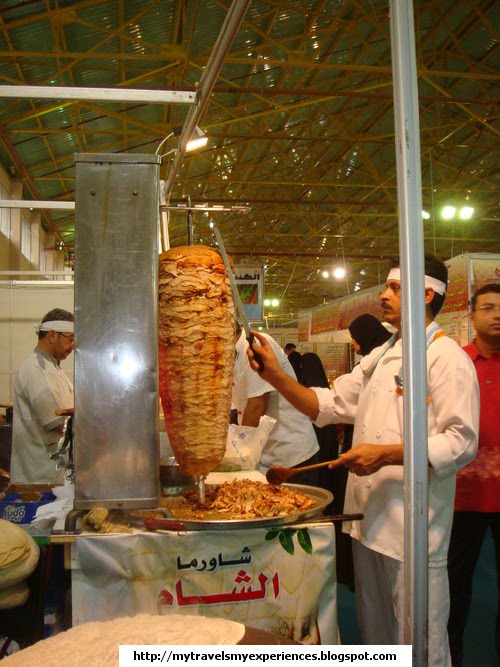
Shawarma


SHAWARMA is a Middle Eastern sandwich-like wrap of shaved lamb, goat, chicken, turkey, beef, or a mixture thereof. The meat is placed on a spit, and may be grilled for as long as a day. Chunks of fat within the meat ensure that the shawarma stays juicy. Shawarma is a fast-food staple across the Middle East. The place of origin of shawarma is Turkey, and in Turkish it is called döner kebab.


It is eaten with pita bread, tabouli, fattoush, taboon bread, tomato and cucumber. Toppings include tahini, hummus, pickled turnips and amba.

Shawarma is made by placing strips of beef, lamb or marinated chicken on a stick; an onion or tomato is placed at the top of the stack for flavoring. The meat is roasted slowly on all sides as the spit rotates in front of, or over, a flame for hours (see rotisserie). Traditionally a wood fire was used, now a gas flame is common. While specialty restaurants might offer two or more meat selections, some establishments have just one skewer.


After cooking, the meat is shaved off the stack with a large knife, an electric knife or a small circular saw, dropping to a circular tray below to be retrieved. Shawarma is eaten as a fast food, made up into a sandwich wrap with pita bread or rolled up in an Armenian Lavash flatbread together with vegetables and dressing. Vegetables found in shawarma include cucumber, onion, tomato, lettuce, eggplant, parsley, pickled turnips, pickled gherkins, cabbage, and in some countries, such as Romania, Bulgaria, Jordan, Israel, or the Arab states of the Persian Gulf, french fries.

Dressings include tahini (or tahina), Amba sauce (pickled mango with Chilbeh) and hummus, flavored with vinegar and spices such as cardamom, cinnamon, and nutmeg. Chicken shawarma is served with garlic mayonnaise, toum (garlic sauce), pomegranate concentrate, or skhug (a hot chili sauce). Once the shawarma is made, it might be dipped in the fat dripping from the skewer and then briefly seared against the flame. In Israel, Syria and Lebanon, chicken shawarma are toasted after being made up, whereas those made of lamb or beef are immediately eaten.
Beef can be used for shawarma instead of just lamb, and turkey is used instead of chicken. In Saudi Arabia, goat is as common as beef or lamb. Less common alternatives include fish and sausage. Some shawarma stores use hot dog buns or baguettes, but most have pita and lafa. Sometimes, beef shawarma—despite its name—contains some lamb in addition to the beef, to ensure juiciness.
( Information taken from Wikipedia)

There are many shops in Kuwait selling "Shawarma" but till now I ate the best shawarma in the shop near Mangaf Sultan Center. When you will stand in front of the entrance, in the car parking area , you will get to see the shop.

Do try it out.....you will enjoy it !

Entertainment City, Q8

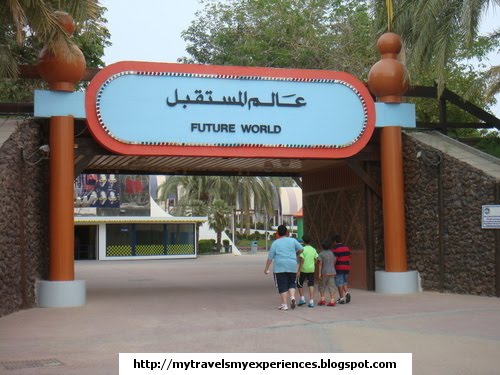
Entertainment City Kuwait is the answer of Disneyland located at Doha around 20 kilometers from the Kuwait city. This huge theme and amusement park is one of the biggest attractions of Kuwait city.

Entertainment City or locally known by the name of Al-Madina Al-Tarfihiya is a great place to spend the day and evening with friends and family with.


It was opened in February of 1983 and located on 124 acres of beautiful Arabian country. The project cost approximately 80 million dollars to build the park. The theme park is managed and operated by the Kuwait Touristic Enterprises Company (TEC). They try to provide a unique and fun atmosphere for all ages. The Company is also in charge of encouraging tourism and controlling entertainment projects.


The park is open Sundays to Fridays in summer and winter, so everyday except Saturdays. The only thing is the hours change a little bit depending on the season. They are open longer in summer time than they are in the winter. And don't worry, they have warm winters too! On Mondays the park is closed down for a women's day only. So no men allowed on Mondays!

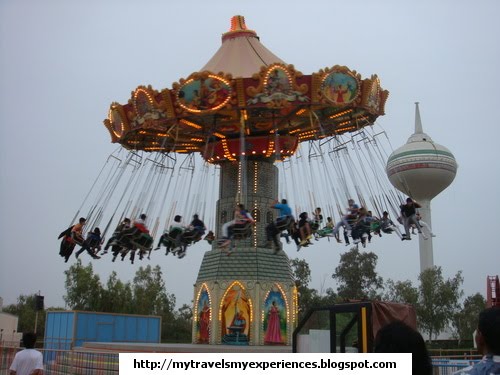
Prior to the Iraqi invasion this huge theme park is considered as the largest fun place of its kind in the entire Gulf area. This theme park of Kuwait offers entertainment means for persons of every age. It provides a complete range of amusements based on three different themes: Arab World, International World and Future World. Major attractions are the City of Dreams, the City of Sinbad and Ali Baba, the City of Thunder and Hurricanes, the City of Roller Coasters, the African boat, Grand Pix, American Railbroad, Arabian Carousel and the Fantasy Cinema. This miniature Disney Land offers more than 40 rides, games and and stage show unique to the Middle East.


It is surrounded by gorgeous green scenery, which on some of the rides you get a great view of. There are some awesome places in the park where you can order and try some specialty foods from there. There are also many different shops where you can buy souvenirs and other merchandise.

The entrance fee to this amusement park is only KD 3.500 per person, an all-in price that allows the ticket holder to enjoy a choice of rides and amusements without paying extra. But games like Wild Raft, Grand Prix, Fantawild 4D Theatre, Giant Slide and New Ride are not included in the entrance ticket price. You need to purchase ticket for these games separately.


Opening Hours (Summer): From Sunday to Friday 5 pm to 1am . Saturday closed.
Opening Hours (Winter): Sunday to Wednesday 3 pm to 11 pm and from Thursday to Friday 10am to 10 pm. Saturday closed.

This was my third visit to the Entertainment City and every time I enjoyed a lot. The best thing about this visit.......Mehr was with us. She was scared at first but later enjoyed the rides.