Out of the various sweet experiences that I have lived already, the visit to Paonta Sahib has deeply impacted me. Paonta Sahib is a small town in Himachal Pradesh, about 50kms away from Dehradun. The journey to this beautiful town nestled in a foothill on the banks of the river Yamuna surrounded by sal trees is picturesque. The road goes through expansive sugarcane fields and curves by the side of the pristine Yamuna to reach this town. On the way one finds a bird-watching point and a hydro electric power plant. This place that has great sanctity for the Sikhs, is also a bustling township with growing industries. The name of the city is derived from “paon” meaning “foot” either because Guru Govind Singh set foot in this place. According to an alternative story, because he lost an ornament which he wore on his foot called a “paonta” while bathing in the river Yamuna which flows here, this place got its name. Having come from the blue mountain and red river state of Assam I felt at home with this beautiful hilly region by the river. However, I had no reason to believe that there would exist a relationship between this small town with our state Assam, but it has a connection and one has to go back to the past to understand it.
Guru Tegh Bahadur, the 9th Sikh guru and father of the 10th guru,Guru Govind Singh had visited Assam to spread the message of Guru Nanak. During this time the family of Raja Ratna Rai of Assam became a disciple of the Guru. Later on the Raja visited Guru Govind Singh at Anandpur in Punjab. During his visit he is said to have presented a majestic elephant and other unusual and expensive gifts to the Guru as a mark of his obeisance. He also prayed that only the Guru rides the elephant and uses the gifts. But as the story goes, the greedy Raja of Anandpur, Bhim Chand eyed the elephant and wanted to grab it.Thus he sent one of his ministers to get the elephant and the priceless gifts on the pretext of his son’s marriage. The Guru, however understood the wrong intentions of the Raja and declined to offer him the same. This angered the Raja who became an enemy of the Guru. At that time Sikhism was spreading rapidly and this warrior cult had become a threat to the Mughal Empire. Emperor Aurangzeb thus sided with the Raja as he felt if the Sikh Guru is confronted and subdued without his direct interference, then it would be good for the empire. Thus with the backing of the emperor, the Raja tried to threaten the Guru into submission, and thus wanted to spring a reason for battle.
In the meantime, conflicts between the Rajas in the Baaisdhar region were at a peak. The Raja of Srinagar Garhwal Phatshah had grabbed the land belonging to the Raja of Nahan, Medini Prakash and the latter was not in a position to secure the release of this land. He took counsel of the famous sage Kalpi, who advised him to invite Guru Govind Singh to his province and take his blessings. Raja Medini Prakash recognized that if the Guru comes to stay in his province peace will descend without waging a battle with Phatshah. Thus he respectfully sent his invitation to the Guru and requested him to make his province his residence.The Guru felt that the strained relations with the Raja of Anandpur will not allow for a peaceful atmosphere to do literary work.
When the Guru arrived at Nahan, the Raja, his ministers, followers and the citizens gave him a rousing reception. The Guru travelled extensively across the province. He was enchanted by the natural beauty of the place which is the present day Paonta Sahib and decided to make this his abode for over four years. He composed his “Dasam Granth” sitting on the banks of the river. Legend says that the mighty Yamuna was flowing very fiercely while the Guru was writing his Grant. So he requested mother Yamuna to slow down so that it does not disturb him. The Yamuna followed his advice and one can notice the mildness of the river near Paonta Sahib.
Within the precincts of the Gurudwara are the Sri Talab Asthan where he disbursed salaries and the Sri Dastar Asthan where he judged the turban tying competitions. At Kavi Darbar Asthan, poetic symposia were held. There is also a museum that displays pens of the Guru and weapons of the time. Also there are information about various Sikh leaders and Gurus. The Guru left Paonta Sahib after the battle of Bhangani with Raja Fateh Shah, in which he defeated the errant ruler’s army after thirty days of battle.
Walking down the precincts of the gurudwara is relaxing. One can see hundreds of devotees praying and listening to the Gurubani. It was my first ever visit to a gurudwara. We took our turn to have the community lunch-“Langar”. It was indeed an experience to sit and have a meal together with hundreds of people in an orderly fashion. We could see many people voluntarily working in the community kitchen-cooking, cleaning and serving. I could see a connection with the Assamese Bhooj in the “Naamghar”.
Isn’t our culture and history too strong to bind us wherever we may live? With this realization I returned home.
Thursday, April 15, 2010
Oil Town Of Assam, India- DIGBOI
Before relocating to Kuwait, we resided at Duliajan, a famous oil town of Assam,India. It is the headquarters of Oil India Limited. Once we planned to spend the weekend in our neighboring town Digboi which is regarded as the oil town of Assam. I waited with anticipation and excitedness for the weekend and finally the day arrived. It was a Friday and we had decided to drive in the evening from our Duliajan to Digboi. It’s approximately 28 km from Duliajan and took us one hour. I was lost in the scenic beauty as my husband maneuvered our little car through the tea gardens, coal fields and the refinery. Finally we arrived at the old town of Digboi. It was my first visit and so I was totally spell bound by the natural beauty and the history of the town.
As we drove, my husband informs me that Digboi has the oldest operating and second oldest oil field in the world. Oil was struck long before it was found in Middle East. Along with the coal mines and tea estates it is richest area in entire North East. According to stories it was an elephant with oil on its feet that led men engaged in laying railway tracks near Digboi to where the oil was. That coupled with endeavor from Mr Goodenough of Mckillop Stewart and Co. culminated in the first successful mechanically drilled oil well in Asia at Nahorpung near Digboi in 1867.According to legend it was Goodenough’s excited and inspiring urge to his men to “dig boy,dig” that gave this picturesque town its name.
Built by the British it has the same colonial look. Its clean, tree lined streets, spacious bungalows surrounded by fragrant gardens, lawns and playgrounds make it unique. Life here is aristocracy as oil executives spend time in the Digboi Club and plays golf in its world class golf course with 18 holes. It would not be wrong to call Digboi a Golfing Resort with nearly eight golf courses within its vicinity ,each with its individual character and challenges.
Next day after breakfast at AOD guest house we visited the Digboi oil field which houses an oil museum . The trip to the oil field was stimulating and informative. Then we visited the museum which was another unforgettable experience. The history of the town with the development in the oil sector was nicely displayed. Also cars, railway engines used during that period were displayed.
We then proceeded to the War Cemetery where hundreds of Japanese soldiers of Second World War period, remained buried in a far strange land, far away from home. We spent the rest of the day amidst verdigris green tea plantations. With a landscape and climate of a hill station and brimming with flowers of all types, this town is paradise on earth.
Digboi is now headquarter of Assam Oil Division of Indian Oil Corporation Limited. The nearest airport of Dibrugarh is 65km and Tinsukia is its nearest rail head. Delux buses ply regularly from Digboi to different places of Assam.
India is really unique and matchless as even small towns in remote areas of the country have a uniqueness, identity, history and beauty that are beyond compare.
As we drove, my husband informs me that Digboi has the oldest operating and second oldest oil field in the world. Oil was struck long before it was found in Middle East. Along with the coal mines and tea estates it is richest area in entire North East. According to stories it was an elephant with oil on its feet that led men engaged in laying railway tracks near Digboi to where the oil was. That coupled with endeavor from Mr Goodenough of Mckillop Stewart and Co. culminated in the first successful mechanically drilled oil well in Asia at Nahorpung near Digboi in 1867.According to legend it was Goodenough’s excited and inspiring urge to his men to “dig boy,dig” that gave this picturesque town its name.
Built by the British it has the same colonial look. Its clean, tree lined streets, spacious bungalows surrounded by fragrant gardens, lawns and playgrounds make it unique. Life here is aristocracy as oil executives spend time in the Digboi Club and plays golf in its world class golf course with 18 holes. It would not be wrong to call Digboi a Golfing Resort with nearly eight golf courses within its vicinity ,each with its individual character and challenges.
Next day after breakfast at AOD guest house we visited the Digboi oil field which houses an oil museum . The trip to the oil field was stimulating and informative. Then we visited the museum which was another unforgettable experience. The history of the town with the development in the oil sector was nicely displayed. Also cars, railway engines used during that period were displayed.
We then proceeded to the War Cemetery where hundreds of Japanese soldiers of Second World War period, remained buried in a far strange land, far away from home. We spent the rest of the day amidst verdigris green tea plantations. With a landscape and climate of a hill station and brimming with flowers of all types, this town is paradise on earth.Next day early morning we had a panoramic and breathtaking view of the town from the famous Ridge Hill Point. If lucky enough, on clear days one can see the snow covered mountains of the eastern Himalayas.
Before driving back home, we took a drive down the historic Stillwell Road, formerly known as Ledo Road, connecting Ledo near Digboi to Kunming in China. This legendary road built by British general Stillwell used to be the lifeline of the Allied Forces during Second World War lies unused now.
India is really unique and matchless as even small towns in remote areas of the country have a uniqueness, identity, history and beauty that are beyond compare.
Labels:
Assam,
blogsherpa,
digboi,
Duliajan,
India,
North-East States,
Oil town Assam India
Wednesday, April 14, 2010
Magic Of Thread In Ooty (Udhagamandalam) ,India
Today while talking to my friend Savitri, who is from Kerala I suddenly I remembered that the creator of the unbelievable Thread Garden of Ooty(Udhagamandalam),India is a Keralite. I shared with her my experiences and will share with you too about this wonder work. It was during our visit to Ooty we discovered this phenomenon.
OOTY-a cool summer retreat nestling in the depths of the Blue Mountains-the Nilgiris is also the home of exotic and ornamental plants. But for those not impressed with the real thing, there is a garden made entirely of thread and it will not be wrong to regard it as the eighth wonder of the world. Thread Garden is situated in an exhibition form right in front of the famed Ooty Lake. From outside, it was no more than a tarpaulin tent of the sort, which small time magicians put up at popular resorts. It’s about 70 meter in length and 10 meter in breadth. "Pay Rs10 and see a thread garden”, a gaudy poster proclaimed.
Since we had an hour in our hands, we decided to try our luck at the Thread Garden. The tent had nothing except about 150 potted plants, of the kind one sees at every nursery. Some of them had flowers while the others were yet to blossom. Jeet, my husband had a close look at the pots and shouted in disbelief, "Oh my God, these are not genuine!” And only then did the sheer grandeur of that incredible work of art struck us. We were surrounded by unbelievably real looking models of plants and flowers, creepers, climbers, lawns and lotus ponds. The ambience was natural enough for even the sharpest eye to be mistaken. They were all before our eyes and yet it was hard to believe that these were not God's creations, because there was difference even in shade of the colour of the leaves depending on whether they were freshly grown or a few days old. Not only that, every single vein of the leaves was clearly visible.
We were curious to know more about it. We talked to one of the organizers and seeing our enthusiasm he requested us to wait as he went to call the creator. We saw a simply dressed, slightly built, bearded man walking towards us. He introduced himself as Anthony Joseph from Trichur, Kerala. His passion for his creation was obvious as he happily explained to us and cleared our doubts. He explained patiently that none of the plants was machine made. In fact, not even a needle had been used while creating them. That is why the aesthetic masterpiece had taken 50 specially trained artistes and more than 12 years to complete. One could only marvel at the concentration, patience and craftsmanship of these unlettered artisans when one noticed the perfection that helped them avoid any overlapping of knots or gaps. The skillful effects were so elaborate indeed that no computerized machine could ever hope to duplicate them.
He told us that all flower petals and stems were fully wound with thread using shaped stiff canvas base inside for flowers and leaves and steel or copper wires for stem under hand winding. The artistes rotate the fingers holding the thread in a certain position and speed it around the canvas base, to bring out the machine like perfection. Thread filaments are used as buds. He calls his technique "Four Dimensional Handwound Embroidery". Through many scientific and artistic observations and experiments, this method without using needles or machinery was invented.
When we asked him of his decision of setting the garden in Ooty and not in his home state, he told us that he regarded Ooty to be the perfect place to show his creation to the world as it attracts thousands of tourist, both national and international. The move paid off, with several thousand visitors seeing the exhibition ever since it was set up in December 2001. He approached the government but as its regulations do not permit creation of permanent structure near the Ooty Lake. So with permission he erected a temporary structure. Special care has been taken to free the artificial plant nursery from dust and moisture and preserve its colour and texture. He has planned to open more such gardens in different metropolitan cities. The whole effort was supported by Madura Coats, the thread major (where his father worked as a manager), which provided all the threads for the garden. It was a nice experience watching the garden and talking to Antony. He is one of those people, who live their dreams and work relentlessly towards attaining them.
OOTY-a cool summer retreat nestling in the depths of the Blue Mountains-the Nilgiris is also the home of exotic and ornamental plants. But for those not impressed with the real thing, there is a garden made entirely of thread and it will not be wrong to regard it as the eighth wonder of the world. Thread Garden is situated in an exhibition form right in front of the famed Ooty Lake. From outside, it was no more than a tarpaulin tent of the sort, which small time magicians put up at popular resorts. It’s about 70 meter in length and 10 meter in breadth. "Pay Rs10 and see a thread garden”, a gaudy poster proclaimed.
Since we had an hour in our hands, we decided to try our luck at the Thread Garden. The tent had nothing except about 150 potted plants, of the kind one sees at every nursery. Some of them had flowers while the others were yet to blossom. Jeet, my husband had a close look at the pots and shouted in disbelief, "Oh my God, these are not genuine!” And only then did the sheer grandeur of that incredible work of art struck us. We were surrounded by unbelievably real looking models of plants and flowers, creepers, climbers, lawns and lotus ponds. The ambience was natural enough for even the sharpest eye to be mistaken. They were all before our eyes and yet it was hard to believe that these were not God's creations, because there was difference even in shade of the colour of the leaves depending on whether they were freshly grown or a few days old. Not only that, every single vein of the leaves was clearly visible.
We were curious to know more about it. We talked to one of the organizers and seeing our enthusiasm he requested us to wait as he went to call the creator. We saw a simply dressed, slightly built, bearded man walking towards us. He introduced himself as Anthony Joseph from Trichur, Kerala. His passion for his creation was obvious as he happily explained to us and cleared our doubts. He explained patiently that none of the plants was machine made. In fact, not even a needle had been used while creating them. That is why the aesthetic masterpiece had taken 50 specially trained artistes and more than 12 years to complete. One could only marvel at the concentration, patience and craftsmanship of these unlettered artisans when one noticed the perfection that helped them avoid any overlapping of knots or gaps. The skillful effects were so elaborate indeed that no computerized machine could ever hope to duplicate them.
He told us that all flower petals and stems were fully wound with thread using shaped stiff canvas base inside for flowers and leaves and steel or copper wires for stem under hand winding. The artistes rotate the fingers holding the thread in a certain position and speed it around the canvas base, to bring out the machine like perfection. Thread filaments are used as buds. He calls his technique "Four Dimensional Handwound Embroidery". Through many scientific and artistic observations and experiments, this method without using needles or machinery was invented.
When we asked him of his decision of setting the garden in Ooty and not in his home state, he told us that he regarded Ooty to be the perfect place to show his creation to the world as it attracts thousands of tourist, both national and international. The move paid off, with several thousand visitors seeing the exhibition ever since it was set up in December 2001. He approached the government but as its regulations do not permit creation of permanent structure near the Ooty Lake. So with permission he erected a temporary structure. Special care has been taken to free the artificial plant nursery from dust and moisture and preserve its colour and texture. He has planned to open more such gardens in different metropolitan cities. The whole effort was supported by Madura Coats, the thread major (where his father worked as a manager), which provided all the threads for the garden. It was a nice experience watching the garden and talking to Antony. He is one of those people, who live their dreams and work relentlessly towards attaining them.
Happy Rongali Bihu, Assam, India
Bihu is the heart of Assamese people of India. It is the symbol of Assamese culture and festival. The Assamese celebrate three types of Bihu in a year and Rongali Bihu is celebrated to mark the beginning of the New Year. The new year of Assamese calendar usually falls on April 15 and starts with the month 'Bohag'. This is the reason why Rongali Bihu is also called 'Bohag Bihu'. The word 'Rongali' is derived from 'Rong' which means happiness and celebrations. So this festival represents happiness of the society. On the eve of the new year, i.e., a day before the new year 'Goru Bihu' is celebrated. On this day, the cattle’s are worshiped. On the day of New Year, 'Manuh Bihu' is celebrated. This day is the actual Rongali Bihu day and the celebrations start from the very early morning. There is a very important ritual on this day to gift 'Gamocha'(special towel) or 'Bihuan' to the elders. Every kitchen in the state cook various peetha(sweets) and also tasty 'Jolpan'(food) is served.
When it comes to Assamese culture and society the first thing that comes to any one inside or outside of Assam is nothing but Bihu, to be more specific, Rongali /Bohag Bihu. But there is a vast difference as to how we celebrated Bihu as kids and how our children celebrate it today. But whatever may be the influnces, the basic things will not change.
Bihu to me / us meant :
School : We got a week’s holiday for Bihu. We used to discuss with our friends what we would do, about the social visits and the new dress’s we would get.
At Home / Uruka: We are four siblings and apart from the massive household work ma had to do, and the various competitions she used to take part, she made lot of peetha’s, ladoo’s and various other snacks.
Shopping : We used to wait for ma-deuta(mother-father in Assamese) to return from market with lot of enthusiasm. They would bring a car load of new dresses and shoes for the family, including uncle-aunty, cousins, and grandparents and even for the maids. And not to forget the big bundle of gamochas(towels) or rather “ bihuaans” for the aashirvaad(blessing) ceremony on the day of Bihu.
Goru Bihu : Most of the times we would visit our parents ancestral house at Jorhat,Assam,India. It was real fun there. Mama(Uncle in Asssamese) and others remained busy for the special occasion and we would take active part . The cows were taken down to the ponds for a bath and before bath they were massaged with “maah haldi”. Cut pieces of vegetables like brinjal, snake gourd, bitter gourd, cucumber, etc were offered to them in a bamboo stick. While making them eat, we would sing “lau khaa bengenaa khaa bosore bosore baarhi jaa,maar khoru, baaper khoru toi hobi bor goru." Their old ropes were cut and they were loose free for the day. In the evening when they returned home, they are tied with new ropes “Pogha”. Along with Aita and mami’s we also light oil lamps and incense in the cowsheds to ward off mosquitoes and illness.
Husori : is the indomitable part of Rongali Bihu. As kids I remember we used to make husori group with our friends and visit the locality singing Bihu songs and dancing. Also elders forming husori group came to our house to sing and dance. At the end of the performance ma-deuta ( if in Guwahati) or koka-aita(grand pa n grand mom in Assamese) (if in Jorhat) used to give some money to the group in a "sarai " and we all used to take blessings. The husori performances would go on for the entire month.
Manuh Bihu: Ma could make a paste of maah-halodi for us to smear our body before bath. Then we visit our elders, gift them gamochas and touch their feet and take blessings. Most of the time we had the lunch at “ Aaimoni Jetahai’s (my aunt)" house as she was an excellent cook. Jethai is no more today but the tasty food she made for us still remains fresh in our minds.
To save us from natural calamity we pray to God and on the day of the Bihu write on nahor tree “ Masua Ferrea” leaves
"debo debo mahadebo nilogribo jotadharo
baato bristi horongdebo mahadebo namastute"
and put them on doors and windows.
Evening we could visit the “bihu toli’s” and also see the various competitions where ma would take part. On the 3rd day of Bihu we eat plain rice mix with water, which we call “ poitaa bhat” and fan ourselves with bamboo handmade fans so that we can bear the hot summer. On the 7th day we make sabzi (dry curry) with seven types of “saak” and eat.
The bihu activities and celebrations which I took part as a kid is missing today. When I think about my daughter MEHR, I feel sad as she will never enjoy the fun I had as a kid. Of course , Bihu still is celebrated today, but a lot has changed.
When it comes to Assamese culture and society the first thing that comes to any one inside or outside of Assam is nothing but Bihu, to be more specific, Rongali /Bohag Bihu. But there is a vast difference as to how we celebrated Bihu as kids and how our children celebrate it today. But whatever may be the influnces, the basic things will not change.
Bihu to me / us meant :
School : We got a week’s holiday for Bihu. We used to discuss with our friends what we would do, about the social visits and the new dress’s we would get.
At Home / Uruka: We are four siblings and apart from the massive household work ma had to do, and the various competitions she used to take part, she made lot of peetha’s, ladoo’s and various other snacks.
Shopping : We used to wait for ma-deuta(mother-father in Assamese) to return from market with lot of enthusiasm. They would bring a car load of new dresses and shoes for the family, including uncle-aunty, cousins, and grandparents and even for the maids. And not to forget the big bundle of gamochas(towels) or rather “ bihuaans” for the aashirvaad(blessing) ceremony on the day of Bihu.
Goru Bihu : Most of the times we would visit our parents ancestral house at Jorhat,Assam,India. It was real fun there. Mama(Uncle in Asssamese) and others remained busy for the special occasion and we would take active part . The cows were taken down to the ponds for a bath and before bath they were massaged with “maah haldi”. Cut pieces of vegetables like brinjal, snake gourd, bitter gourd, cucumber, etc were offered to them in a bamboo stick. While making them eat, we would sing “lau khaa bengenaa khaa bosore bosore baarhi jaa,maar khoru, baaper khoru toi hobi bor goru." Their old ropes were cut and they were loose free for the day. In the evening when they returned home, they are tied with new ropes “Pogha”. Along with Aita and mami’s we also light oil lamps and incense in the cowsheds to ward off mosquitoes and illness.
Husori : is the indomitable part of Rongali Bihu. As kids I remember we used to make husori group with our friends and visit the locality singing Bihu songs and dancing. Also elders forming husori group came to our house to sing and dance. At the end of the performance ma-deuta ( if in Guwahati) or koka-aita(grand pa n grand mom in Assamese) (if in Jorhat) used to give some money to the group in a "sarai " and we all used to take blessings. The husori performances would go on for the entire month.
Manuh Bihu: Ma could make a paste of maah-halodi for us to smear our body before bath. Then we visit our elders, gift them gamochas and touch their feet and take blessings. Most of the time we had the lunch at “ Aaimoni Jetahai’s (my aunt)" house as she was an excellent cook. Jethai is no more today but the tasty food she made for us still remains fresh in our minds.
To save us from natural calamity we pray to God and on the day of the Bihu write on nahor tree “ Masua Ferrea” leaves
"debo debo mahadebo nilogribo jotadharo
baato bristi horongdebo mahadebo namastute"
and put them on doors and windows.
Evening we could visit the “bihu toli’s” and also see the various competitions where ma would take part. On the 3rd day of Bihu we eat plain rice mix with water, which we call “ poitaa bhat” and fan ourselves with bamboo handmade fans so that we can bear the hot summer. On the 7th day we make sabzi (dry curry) with seven types of “saak” and eat.
The bihu activities and celebrations which I took part as a kid is missing today. When I think about my daughter MEHR, I feel sad as she will never enjoy the fun I had as a kid. Of course , Bihu still is celebrated today, but a lot has changed.
Monday, April 12, 2010
Green Island,Q8 - Venue Of Our Building Picnic
Do you need a place to go this weekend? I have a great suggestion; somewhere to take the whole family to: The Green Island!
The Green Island in Kuwait is known to be the best place for the people to relax. This famous picnic spot, a family orientated park, is actually a reclaimed land which has been transformed to an artificial island. The location of the Green Island, near Kuwait Towers, is in the coastline that extends from Al-Shiwaikh to Ras Alard. This island with an area of 785 thousand square meters and diameter of 3140 meters is linked to the sea by a passage which is 134 meters long. The surrounding natural rocks were brought from Al-Fujairah Emirates. The sides of the Green Island of Kuwait were fortified with concrete, even the sands that you find at the beaches of the Green Island were imported from other countries. You will not believe that you are in a desert country when you are in Green Island, since this place has a riot of colors with the shrubs and seedlings planted here. It’s a long walk to Green Island entrance and also very windy here and not a favorable place to go in winter evenings. However, it is cool during the summertime. On the right of the entrance,one can play Soap-Football during the summer. On the left, there are many inflatable bouncing castles and such for children available in afternoon and evening. You have to pay the entrance fees(500fils per person) at the door. It's a well worth amount because you can easily spend the whole day at the island. First and foremost, if you are a diehard tanning enthusiast, there is a gorgeous beach which allows you to catch the rays. Although it's not a very long shore, it is long enough to spend a nice relaxing day on the beach. By now you're probably thinking, "How can I have a relaxing day at the beach when my kids will be so bored they will drive me crazy?” Well fear not, there are many activities for your kids to enjoy. There is a fun pool, a kid castle, trampolining, bumper cars, and a machine operated high flying swing ride. Also available to all visitors of the Green Island are tourist towers that you can climb by stairs or take the elevator up. This will allow you to see Kuwait from a different angle. The panoramic views form the top of these towers is quit breathtaking. On one side you can see endless water, from the other side you can see the Kuwait towers and from yet another angle of the top of the tower, you can see Kuwait's budding skyscrapers.
It has facilities for everyone from kids to adults too. According to your need you can rent a cycle and move around. As MEHR was with me, I could not cycle it, so my friends gave me a ride in the 4wheeler cycle. The smaller cycle (2tires) will cost you 500fills for half an hour and the bigger one (4 wheeler/ 4seater) will cost you 5KD for an hour. There is also a train available; at 250fills per person which will give you a full ride around the Island. The best time to ride the train is in the evening hours or night time. It is a wonderful place to walk where you don't have to worry about cars. There is an amphitheatre where some musical concerts and plays take place. And in the artificial "lake" one can rent pedalos. It is a very quiet and serene place for couples who want to spend time alone too.
Our husbands got busy playing cricket, ladies in cycling or making their kids play in the play-area, while bigger kids moved around in their own group. It was nice to see all of us relaxed, playing and enjoying. After some time we had a short break as we had snacks and tea/juice. We had games …..One for ladies alone, another two games for the couples. All of them participated and it was fun to see all getting involved as kids. At around 7pm our dinner arrived, which we ordered from Hotel Kohinoor( matar panner; butter chicken, mixed vegetable, chappati and gulab jammun). We cooked plain rice and prepared raita and salad at home. We felt like staying back for some more time, but it was already 9.30pm and children had schools the next day. So, had to return promising to visit again soon.
Recently, I had the opportunity to visit the Green Island and spent a few hours discovering all its beauty. This weekend, on Saturday, our building friends planned to go for a picnic. The entire outing was planned by the ladies….from the venue to food to games. A total of 18 families went, so it was relatively a very big group. After lunch we planned to meet at around 3pm at the lobby of our building. By the time we all started in our respective cars it was 3.30pm. We were little late, we started at around 4pm as we had to attend another friend Debashis and Lata’s son Aadi’s birthday party for lunch at Hotel Caesar’s. It was my first visit so I was more excited. It took us nearly 40minutes to reach our venue from our house.
The Green Island in Kuwait is known to be the best place for the people to relax. This famous picnic spot, a family orientated park, is actually a reclaimed land which has been transformed to an artificial island. The location of the Green Island, near Kuwait Towers, is in the coastline that extends from Al-Shiwaikh to Ras Alard. This island with an area of 785 thousand square meters and diameter of 3140 meters is linked to the sea by a passage which is 134 meters long. The surrounding natural rocks were brought from Al-Fujairah Emirates. The sides of the Green Island of Kuwait were fortified with concrete, even the sands that you find at the beaches of the Green Island were imported from other countries. You will not believe that you are in a desert country when you are in Green Island, since this place has a riot of colors with the shrubs and seedlings planted here. It’s a long walk to Green Island entrance and also very windy here and not a favorable place to go in winter evenings. However, it is cool during the summertime. On the right of the entrance,one can play Soap-Football during the summer. On the left, there are many inflatable bouncing castles and such for children available in afternoon and evening. You have to pay the entrance fees(500fils per person) at the door. It's a well worth amount because you can easily spend the whole day at the island. First and foremost, if you are a diehard tanning enthusiast, there is a gorgeous beach which allows you to catch the rays. Although it's not a very long shore, it is long enough to spend a nice relaxing day on the beach. By now you're probably thinking, "How can I have a relaxing day at the beach when my kids will be so bored they will drive me crazy?” Well fear not, there are many activities for your kids to enjoy. There is a fun pool, a kid castle, trampolining, bumper cars, and a machine operated high flying swing ride. Also available to all visitors of the Green Island are tourist towers that you can climb by stairs or take the elevator up. This will allow you to see Kuwait from a different angle. The panoramic views form the top of these towers is quit breathtaking. On one side you can see endless water, from the other side you can see the Kuwait towers and from yet another angle of the top of the tower, you can see Kuwait's budding skyscrapers.
It has facilities for everyone from kids to adults too. According to your need you can rent a cycle and move around. As MEHR was with me, I could not cycle it, so my friends gave me a ride in the 4wheeler cycle. The smaller cycle (2tires) will cost you 500fills for half an hour and the bigger one (4 wheeler/ 4seater) will cost you 5KD for an hour. There is also a train available; at 250fills per person which will give you a full ride around the Island. The best time to ride the train is in the evening hours or night time. It is a wonderful place to walk where you don't have to worry about cars. There is an amphitheatre where some musical concerts and plays take place. And in the artificial "lake" one can rent pedalos. It is a very quiet and serene place for couples who want to spend time alone too.
Our husbands got busy playing cricket, ladies in cycling or making their kids play in the play-area, while bigger kids moved around in their own group. It was nice to see all of us relaxed, playing and enjoying. After some time we had a short break as we had snacks and tea/juice. We had games …..One for ladies alone, another two games for the couples. All of them participated and it was fun to see all getting involved as kids. At around 7pm our dinner arrived, which we ordered from Hotel Kohinoor( matar panner; butter chicken, mixed vegetable, chappati and gulab jammun). We cooked plain rice and prepared raita and salad at home. We felt like staying back for some more time, but it was already 9.30pm and children had schools the next day. So, had to return promising to visit again soon.
Friday, April 09, 2010
Dubai Metro / Dubai Taxi
The next day we just moved around Meena Bazar purchasing dresses for Mehr and few souvenirs as gifts for family and friends. Then we went to the nearby metro station, near Burjuman Mall as we decided to have an experience of travelling through the Dubai’s Metro. On 9 September 2009, Dubai inaugurated its metro network, becoming the first urban metro network in the Gulf's Arab states. All trains and stations are air conditioned with platform edge doors to make this possible. We booked our tickets to Mall of Emirates station. The stations were meticulously clean and tidy. From the ground floor one can use the conveyer staircase or elevator which takes to the level of the metro station. A glass wall with sliding doors separates the tracks from platform for safety and security. When the metro train arrives, the glass-doors and the train doors open automatically and simultaneously. As the commuters enter the train, after few seconds both the doors close following an announcement: ‘Please stand clear of the door’. The entire metro system runs automatically as there is neither a driver (motorman) nor a guard on the metro train. We had lunch at one of the restaurants of the Mall of Emirates and returned to Burjuman Mall station again. Did hear that Dubai’s metro is world class and its really true.
We checked out of the hotel at around 4pm and took a cab/ taxi from our hotel to the airport. On the way, while Jeet talked to the driver and we came to know that taxis in Dubai are owned by the government. There are five companies under government. The top most part of the cab/ taxi has a colour….the five companies have five colours…red, blue(own by an Indian and Arabic), green, yellow and orange. Thus we come to know to which company the cab belongs to by the colour.
We had our flight to New Delhi late at night, so had to wait a long time at the airport. Mehr made lot of friends but it was very boring for me. We wait'd at Terminal1, and I checked out the few shops that were there to pass my time.
Our vacation in Dubai is a memorable one. I love’d Dubai and will surely go back again. With a perfect winter climate, top class hotels, superb facilities for a variety of sports and leisure activities and excellent shopping, Dubai has something to offer everyone. Moreover, the emirate is friendly, safe and virtually crime-free. What more can a traveller ask for???
We checked out of the hotel at around 4pm and took a cab/ taxi from our hotel to the airport. On the way, while Jeet talked to the driver and we came to know that taxis in Dubai are owned by the government. There are five companies under government. The top most part of the cab/ taxi has a colour….the five companies have five colours…red, blue(own by an Indian and Arabic), green, yellow and orange. Thus we come to know to which company the cab belongs to by the colour.
We had our flight to New Delhi late at night, so had to wait a long time at the airport. Mehr made lot of friends but it was very boring for me. We wait'd at Terminal1, and I checked out the few shops that were there to pass my time.
Our vacation in Dubai is a memorable one. I love’d Dubai and will surely go back again. With a perfect winter climate, top class hotels, superb facilities for a variety of sports and leisure activities and excellent shopping, Dubai has something to offer everyone. Moreover, the emirate is friendly, safe and virtually crime-free. What more can a traveller ask for???
Labels:
blogsherpa,
Dubai,
dubai metro,
dubai taxi,
Middle East,
UAE,
United Arab Emirates
Thursday, April 08, 2010
Heritage Village- An Interactive Look at Dubai ’s Past.
Just a few steps ahead is the Heritage Village, full with activities. A traditional heritage village, located near the mouth of the Creek, has been created where potters and weavers display their crafts. It focuses on the UAE’s maritime past, trading activities and local history. There are several traditional shops, handicraft stores and exhibitions—you can also ride a camel. It’s a great place to see the more traditional aspects of Dubai life that are missing from the modern city. Here the visitor can look back in time and experience some of Dubai’s heritage. There are displays, which include a tented Bedouin village with traditional weapons, chests and household utensils.
It reminded me of Dilli Haat (a combination food plaza and craft bazaar located in the heart of Delhi. It has stalls representing each state of India, giving a complete variety of tastes available all over India.) The Heritage Village has many shops selling souvenirs, but the shop keepers are mainly Indians or Bangladeshi’s. They speak and dress like a Arabic and sometimes it becomes difficult to understand that they do not belong to Dubai. Here you need to do hard bargaining. We purchased a spoon and freeze magnet as souvenir from a shop whose owner was from Kerala, India. There are also many small shops run by Bedouin women, where they make and sell varieties of food items mainly sweets. It was a pleasure to see live demonstration of Arabic food being made. While I took rest on a bench, and was feeding MEHR, Jeet went and purchased few Arabic roti's, filled with omlette and cheese. It was really very tasty. The Arabic food stall was full with customers and you have to wait for a long time for your turn. The village was full with not only tourist but also local Arabic people as it was Eid holiday.
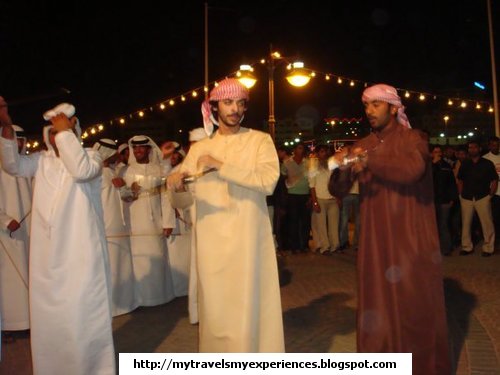
During Eid special programmes are held. So we got the opportunity to see a Bedouin marriage. I was sitting next to an Arabic family. They were very friendly and explained me in details the rituals of the marriage. At first the bride’s family came, singing and playing musical instrument. There were no male/ gents in the group; only ladies. They were making so much noise that we were confused as to what was happening. Then the Arabic lady next to me told me that it is a marriage ceremony that is going to take place and that the bride is coming with her relatives and friends. Her relatives in box’s and trunks carried things that would be given to her for marriage (cloths, accessories, jewellery etc). Even one of them was carrying a pillow. After they took their seat, they showed to public one by one all the items. They sang marriage songs and in the middle of the songs would make some noise from their mouth, which we call “uruli” in Assamese (India). In the same way, the bridegroom came with his relatives and friends. In the village the traditional dance and songs were also performed as part of the wedding. Folk dance and music performances are staged from time to time in the village.
The village boasts a number of cafeterias and a seafood restaurant. The village provides a glimpse of Dubai’s traditional culture and lifestyle. Thus it is an enjoyable, interactive look at Dubai ’s past.
For more you can check the website: http://www.dubaicity.com/What_to_do_in_dubai/dubai_heritage.htm
Near the Village, are two Arabic restaurants. They must be very popular as it was over crowded. The people were smoking sheesha, eating, enjoying the fresh air of the sea and the Creek side view. We could not find a place so decided to walk down to our hotel. On our way to the hotel, we visited Meena Jewellery and checked out few earnings and chains. It was late and it was time for the shop to close. Anyway I did not like the designs and decided to check shops later, the next day. We had dinner at Bhavna Veg Restaurent. It cost us 13 dirham per person; quite cheap. They gave lot of things..Plain rice, pulao, two vegetable sabzi, 2 chutney’s, roti, aachar, lachi,dal, kofta,lemon and papar. But the food was not very tasty (ok type) and the restaurant especially the basin / hand wash area was very dirty.
We hurried back as it was getting late to feed MEHR.
It reminded me of Dilli Haat (a combination food plaza and craft bazaar located in the heart of Delhi. It has stalls representing each state of India, giving a complete variety of tastes available all over India.) The Heritage Village has many shops selling souvenirs, but the shop keepers are mainly Indians or Bangladeshi’s. They speak and dress like a Arabic and sometimes it becomes difficult to understand that they do not belong to Dubai. Here you need to do hard bargaining. We purchased a spoon and freeze magnet as souvenir from a shop whose owner was from Kerala, India. There are also many small shops run by Bedouin women, where they make and sell varieties of food items mainly sweets. It was a pleasure to see live demonstration of Arabic food being made. While I took rest on a bench, and was feeding MEHR, Jeet went and purchased few Arabic roti's, filled with omlette and cheese. It was really very tasty. The Arabic food stall was full with customers and you have to wait for a long time for your turn. The village was full with not only tourist but also local Arabic people as it was Eid holiday.
During Eid special programmes are held. So we got the opportunity to see a Bedouin marriage. I was sitting next to an Arabic family. They were very friendly and explained me in details the rituals of the marriage. At first the bride’s family came, singing and playing musical instrument. There were no male/ gents in the group; only ladies. They were making so much noise that we were confused as to what was happening. Then the Arabic lady next to me told me that it is a marriage ceremony that is going to take place and that the bride is coming with her relatives and friends. Her relatives in box’s and trunks carried things that would be given to her for marriage (cloths, accessories, jewellery etc). Even one of them was carrying a pillow. After they took their seat, they showed to public one by one all the items. They sang marriage songs and in the middle of the songs would make some noise from their mouth, which we call “uruli” in Assamese (India). In the same way, the bridegroom came with his relatives and friends. In the village the traditional dance and songs were also performed as part of the wedding. Folk dance and music performances are staged from time to time in the village.
The village boasts a number of cafeterias and a seafood restaurant. The village provides a glimpse of Dubai’s traditional culture and lifestyle. Thus it is an enjoyable, interactive look at Dubai ’s past.
For more you can check the website: http://www.dubaicity.com/What_to_do_in_dubai/dubai_heritage.htm
Near the Village, are two Arabic restaurants. They must be very popular as it was over crowded. The people were smoking sheesha, eating, enjoying the fresh air of the sea and the Creek side view. We could not find a place so decided to walk down to our hotel. On our way to the hotel, we visited Meena Jewellery and checked out few earnings and chains. It was late and it was time for the shop to close. Anyway I did not like the designs and decided to check shops later, the next day. We had dinner at Bhavna Veg Restaurent. It cost us 13 dirham per person; quite cheap. They gave lot of things..Plain rice, pulao, two vegetable sabzi, 2 chutney’s, roti, aachar, lachi,dal, kofta,lemon and papar. But the food was not very tasty (ok type) and the restaurant especially the basin / hand wash area was very dirty.
We hurried back as it was getting late to feed MEHR.
Subscribe to:
Posts (Atom)